
Walk through any refinery, power plant, or process facility and most of the pipework you see is wrapped — insulation underneath, a metal cladding jacket on top. That wrapping is essential for energy efficiency, process control, and personnel safety. But it also creates a problem: once a pipe is insulated, you can no longer see the metal surface, and you cannot easily check it for corrosion or damage.
An insulation inspection plug solves exactly that problem. It is a permanent, reusable access port built into the insulation system that lets you reach the pipe or vessel surface underneath — and then seal it back up — without tearing off the cladding. This article explains what an inspection plug is, the parts it is made from, and precisely how it works.
A Simple Definition
An insulation inspection plug is a sealed opening fitted into insulated piping or equipment. It provides a small, ready-made window down to the metal surface, closed by a removable plug or cap that restores an airtight, watertight seal every time it is shut.
Think of it as a permanent inspection door in the insulation. Instead of cutting the cladding open and rebuilding it each time you need to look, you fit the plug once and then simply open and close it whenever an inspection is due. The insulation and cladding stay intact, and the access point is reusable for the life of the asset.
Why Insulated Equipment Needs an Inspection Point
The reason inspection plugs exist comes down to one of the most expensive integrity threats in industry: Corrosion Under Insulation (CUI). Insulation is porous, so water from rain, washdown, steam, or condensation can work its way in and become trapped against a warm pipe. Held there by the insulation, that moisture quietly corrodes the metal — and because the cladding looks perfectly fine from outside, the damage stays hidden until something leaks or fails.
The only way to manage that risk is to inspect insulated equipment regularly. An inspection plug makes regular inspection practical, because it removes the biggest obstacle: the need to destroy and rebuild the insulation every single time.
The Anatomy of an Insulation Inspection Plug
To understand how an inspection plug works, it helps to know what it is made of. A typical assembly is built from a handful of purpose-designed parts:
- The sealing element — the heart of the plug. This is either an industrial-grade silicone plug or a high-quality EPDM sleeve. It is the flexible component that compresses to form the airtight, watertight seal against the opening.
- The flange or metal cap — the structural closure. In the silicone design this is a stainless steel flange with integrated fixing holes that mounts flush into the cladding; in the sleeve design it is a metal plug cap that fits into the elastomer sleeve.
- The locking ring — secures the cap firmly in place so the seal stays under proper compression during service.
- The handle — gives the technician a positive grip to remove and refit the cap quickly, even with gloves on.
- The lanyard — a stainless steel tether that keeps the cap attached to the assembly so it cannot be dropped or lost during inspections, which is especially important when working at height.
- Replacement insulation material — packs the bore behind the cap so the access point does not become a thermal weak spot or a cold bridge in the insulation.
*[Optional: insert your exploded-view component diagram from the data sheet here — it illustrates this section perfectly. Suggested alt text: "Exploded view of an insulation inspection plug showing sleeve, locking ring, cap, handle and lanyard."]*
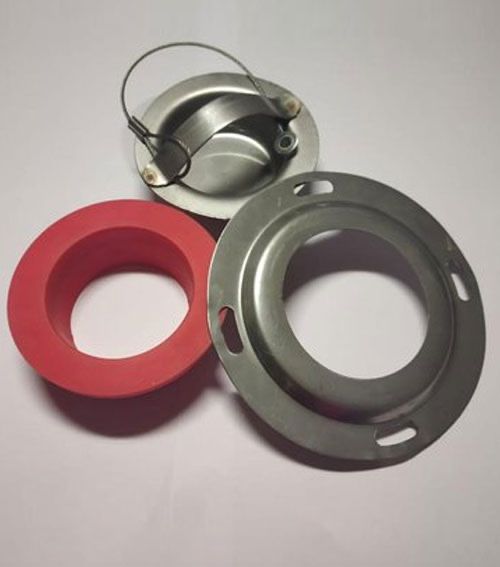
How an Insulation Inspection Plug Works
The plug works in two phases: a one-time installation, and then repeated open-and-close inspections for years afterward.
Installation (done once). A small, neat opening is made through the cladding and insulation down to the pipe surface. The sealing element is fitted into that opening — the stainless steel flange is fixed flush to the cladding in the silicone design, or the elastomer sleeve lines the opening in the sleeve design. Replacement insulation fills the bore so the thermal envelope is maintained. No special tools, O-rings, transition gaskets, contoured flanges, or improvised "goof" fittings are needed to make it seal.
Sealing. When the plug or cap is seated, the elastomer is compressed against the sidewall of the opening, creating a continuous airtight and watertight barrier. In the silicone version, the plug's convex bottom is the clever detail: it presses outward against the flange wall and keeps that sealing pressure up over the long term, automatically compensating for any shrinkage as the material ages. That is what turns a temporary seal into a permanent one.
Inspection (repeated). When an inspection is due, the technician releases the locking ring, grips the handle, and lifts out the plug or cap — the lanyard keeping it tethered the whole time. With the port open, they can perform a visual check or insert NDT equipment such as an ultrasonic thickness gauge, borescope, or pit gauge directly onto the metal surface.
Resealing. Once the check is complete, the plug or cap is pushed back into place and locked. The elastomer re-compresses, the seal is restored instantly, and the insulation system is fully closed and weatherproof again — ready for the next inspection whenever it is needed.
The Two Main Types
Inspection plugs come in two complementary designs, and choosing between them is mostly about temperature and environment.
|
Feature |
Silicone Plug Type |
EPDM Sleeve & Metal Cap Type |
| Sealing element | Industrial-grade red silicone plug with convex sealing base | High-quality EPDM elastomer sleeve |
| Closure | 304 stainless steel flange with integrated holes | Metal plug cap (304 SS or aluminium) |
| Options | Permanent airtight/watertight seal | With or without handle, lanyard, locking ring |
| Temperature range | −50 °C to 600 °C (−58 °F to 932 °F) | Colour-coded grades for different temperature bands |
| Sizes | 1", 2", 3", 4", 5" | 1.5", 2.0", 2.5", 3.0/3.5", 5" (38–127 mm) |
| Best for | Highest temperatures, longest seal life | General industrial service, excellent value |
Both types do the same fundamental job — a permanent, reusable, sealed access port — so the right choice depends on your line temperature, chemical exposure, and budget.
Materials, Sizes, and Temperature Ratings
The sealing elements are industrial silicone or EPDM, and the hardware — caps, flanges, locking rings, handles, and lanyards — is made from 304 stainless steel or aluminium for strength and corrosion resistance in harsh plant environments. The stainless steel is produced to ASTM A240, giving excellent chemical, ozone, water, weathering, UV, and fire resistance.
Sizes span small instrument-scale ports up to 5" (127 mm) openings, and the silicone design is rated for service line temperatures all the way up to 600 °C. (The elastomer itself runs much cooler than the pipe, because it seals at the outer cold-face of the insulation rather than against the hot metal — which is why such high line temperatures are achievable.)
Where Insulation Inspection Plugs Are Used
Inspection plugs are used wherever insulated equipment needs to be checked without disturbing the insulation system. Typical applications include insulated process and utility piping, pressure vessels, storage tanks, columns, and exchangers across refineries, petrochemical plants, power stations, and similar facilities. Within those assets, plugs are positioned at the points most prone to CUI — low points and dead legs, pipe supports and penetrations, areas around valves and flanges, and any location where the weather barrier may be compromised.
Why It Matters
An insulation inspection plug turns a destructive, expensive, half-day excavation into a quick, repeatable check that one technician can complete in minutes. It keeps the cladding intact, preserves the integrity of the insulation, and — most importantly — gives you a reliable way to catch corrosion before it becomes a failure. In a CUI inspection programme, it is the difference between inspecting often and inspecting almost never.
In Summary
An insulation inspection plug is a permanent, reusable, sealed access port built into insulated piping and equipment. It is made up of a flexible sealing element (silicone or EPDM), a metal flange or cap, and supporting hardware like a locking ring, handle, and lanyard. It works by compressing the elastomer to form an airtight, watertight seal that can be opened for inspection and resealed in seconds — over and over, for the life of the asset.
*Want help specifying the right plug for your equipment? Share your pipe sizes, line temperatures, and operating environment with the METALX team, and we will recommend the ideal configuration.*